Problem Guide
Search by name or symptom, filter by problem type and affected plant part.
Problem Type
Affected Part
Found: 31

Aphids
These are small green (sometimes reddish, brown) flies that usually attack in swarms. They suck the sap from leaves or stems, but do not touch the fruits. A tomato plant can withstand significant aphid attacks, but they should not be neglected, as too many can weaken the plant. These flies can also be carriers of viral diseases. A similar species is whiteflies; they act similarly, but are half the size. Aphids are protected by ants: contrary to popular belief, ants do not destroy aphids, but help them thrive.

Spider mites
A creature the size of a salt crystal with two black spots on its back. They usually weave webs on the underside of the leaf, causing the most problems during the hottest and driest summer months. They suck plant sap — yellow spots develop in the affected areas, which later turn brown and die.

Stink bug
A flat, shield-shaped brown or green insect that emits an unpleasant odor when disturbed. It only attacks fruits, preferring green ones. It punctures the skin and sucks the juices, leaving sunken, colorless spots.
Larvae (worms)
There are many worms (usually insect larvae) that can cause minor damage or completely destroy a tomato plant. Eggs hatch after overwintering in the soil, larvae crawl to the surface and settle inside the plant, on the stem or leaves. There are also larvae that live in the soil and feed on roots — the plant grows slowly, stunted. To check for pests in the soil, you can insert a carrot near the seedling and check it every couple of days.

Nematodes
Microscopic roundworms. Harmful root nematodes damage the roots — the plant is undernourished, grows slowly, is weak, and recovers slowly after drought. To check, the plant needs to be pulled out: the root system will be covered with swollen galls.

Bacterial canker
Quite rare, but if it attacks, it can destroy the entire season's harvest. The main symptoms are wilting, curling, and browning of leaves. Initially, not the entire leaf wilts, only a part of it. Even if the plant is infected at the seed stage, symptoms may not appear until flowering. Later, spots with a double border appear on the fruits. The disease spreads rapidly — infected plants must be removed immediately.

Bacterial spot
Manifests as dark spots with a raised center on leaves and stems, later the leaves begin to yellow. Dark, growing spots may appear on the fruits. Cool, humid weather and splashing water droplets allow the disease to spread rapidly.

Early blight and black fruit rot
Alternaria solani
Usually appears when fruits begin to set. First affects the lower leaves, then the stem and fruits. Large brown or black spots with concentric rings appear on them. Around the spot, the leaf begins to yellow and dies. It also attacks potatoes and eggplants. The fungus is resistant and persists for several years.
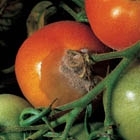
Late blight
Phytophthora infestans
Dark green or black spots appear and spread on the edges of the leaves. The same can appear on the fruits.

Septoria Leaf Spot
Septoria lycopersici
Forms light spots with dark edges, with black dots inside. Later the leaf yellows and falls off. Does not affect fruits. The fungus is resistant, survives winter.

Root Rot
Fusarium oxysporum
Common in tomato gardens. Thrives in warm, acidic soils. Infects the plant through the roots, spreads through the circulatory system. The first symptom is yellowing of the lower leaves; dark brown spots are found when the stem is cut. Can affect potatoes, peppers, eggplants.

Verticillium Wilt
Verticillium albo-atrum / Verticillium dahliae
Symptoms are very similar to root rot, the difference is that this fungus prefers cooler, neutral pH soils. Brown spots may also appear on the leaves in addition to yellowing.

Gray Leaf Spot
Stemphylium solani
Brown or black spots appear on all - old and young - leaves. As the spots expand, the leaf yellows and dies. Likes a humid environment, spreads by water droplets.

Brown Spot (Cladosporium Leaf Mold)
Cladosporium fulvum
Indistinct yellowish spots form on the leaves, and grayish, later brownish fungal growth appears on the underside. In high humidity, many spots appear, and the leaves begin to wilt.

Powdery Mildew
Erysiphe
Irregularly shaped white coating with deposits appears on the leaves, which later turn grayish. Drafts promote the disease.

Mold
Symptoms caused by various fungi. Mold only survives in high humidity.

Damping-off
Pythium, Rhizoctonia
More of a symptom than a disease. Affects only young seedlings: the stem browns and narrows at the roots, the seedling topples over.
Tobacco Mosaic
Solanum virus
The most resistant of viruses - can survive up to 100 years in dry conditions. Most often infected by human contact (smokers can transmit it), infected seeds also occur. Forms variegated dark and light green spots on the leaves. Fruits are not affected, but weakened leaves impact the yield.

Cucumber Mosaic
Cucumis virus
Transmitted by aphids, does not survive winter in soil or plants. The first symptom is leaves with raised stripe-shaped spots, which later appear on the stem and fruits.

Blossom end rot
A large rot appears on the bottom of the fruit. This happens due to a lack of calcium in the fruit. The deficiency can manifest not only due to its absence in the soil, but also due to irregular watering.
Nitrogen deficiency or excess
When deficient — growth slows down, old leaves lose color, newly growing leaves are yellow-green. Nitrogen is quickly broken down or washed out by water. In case of excess — tomatoes grow many leaves, but bloom little and set fruit sparsely.

Magnesium deficiency
Magnesium is an important part of chlorophyll. When it is deficient, the veins of old leaves begin to yellow, while the veins themselves remain green. Later, the symptoms spread to young leaves, which begin to wither.

Potassium deficiency
Potassium is responsible for metabolism in the plant. When deficient — leaves begin to wither, deform, yellow, the stem weakens, fruits fall prematurely. When a young plant is deficient — it grows deformed, the edges of older leaves dry out.

Manganese deficiency
Deficiency causes uneven yellowing of the leaf veins, starting in the top leaves and near the main branches.
Phosphorus deficiency or excess
Phosphorus is necessary for cell growth, flower and fruit formation. When deficient — young plant leaves darken, acquire a purple hue; the growth of an older plant stops, the underside of the leaves and veins are purple. In case of excess — fruits become bitter.

Iron deficiency
Iron is involved in chlorophyll production and helps absorb nitrogen. When deficient — the veins of the top leaves begin to yellow or whiten, while the veins themselves remain green. If the soil pH > 6.8, plants have difficulty absorbing iron.

Irregular fruit shape
Fruits with an irregular shape are sometimes found — scarred, divided into lobes (when this is not characteristic of the variety). This happens due to the effect of low temperature on the flowers, so it usually occurs in early fruits.

Fruit cracking
Scars appearing around or across the tomato. The fruit cracks if it ripens during a hot period and at the same time receives too much water — cracks appear due to too rapid water uptake.

Sunburn
A yellow or white area on the side of the fruit facing the hot sun. Happens due to sparse foliage, when the fruits are not protected from harsh rays. Symptoms can also be a sign of bacterial or fungal disease.

Leaf curling
Usually occurs during a humid period, with over-fertilization. The edges of the lower leaves curl upwards, form tubes, and become hard. This phenomenon does not significantly affect plant growth.
Flower drop
Tomatoes start to drop flowers when the night air temperature exceeds 24 degrees.